Focus on full-chain semiconductor quantum optoelectronics—from telecom single-photon emission to mid-infrared/terahertz quantum cascade lasers and systems—& their applications in sensing, imaging, spectroscopy, and communications.
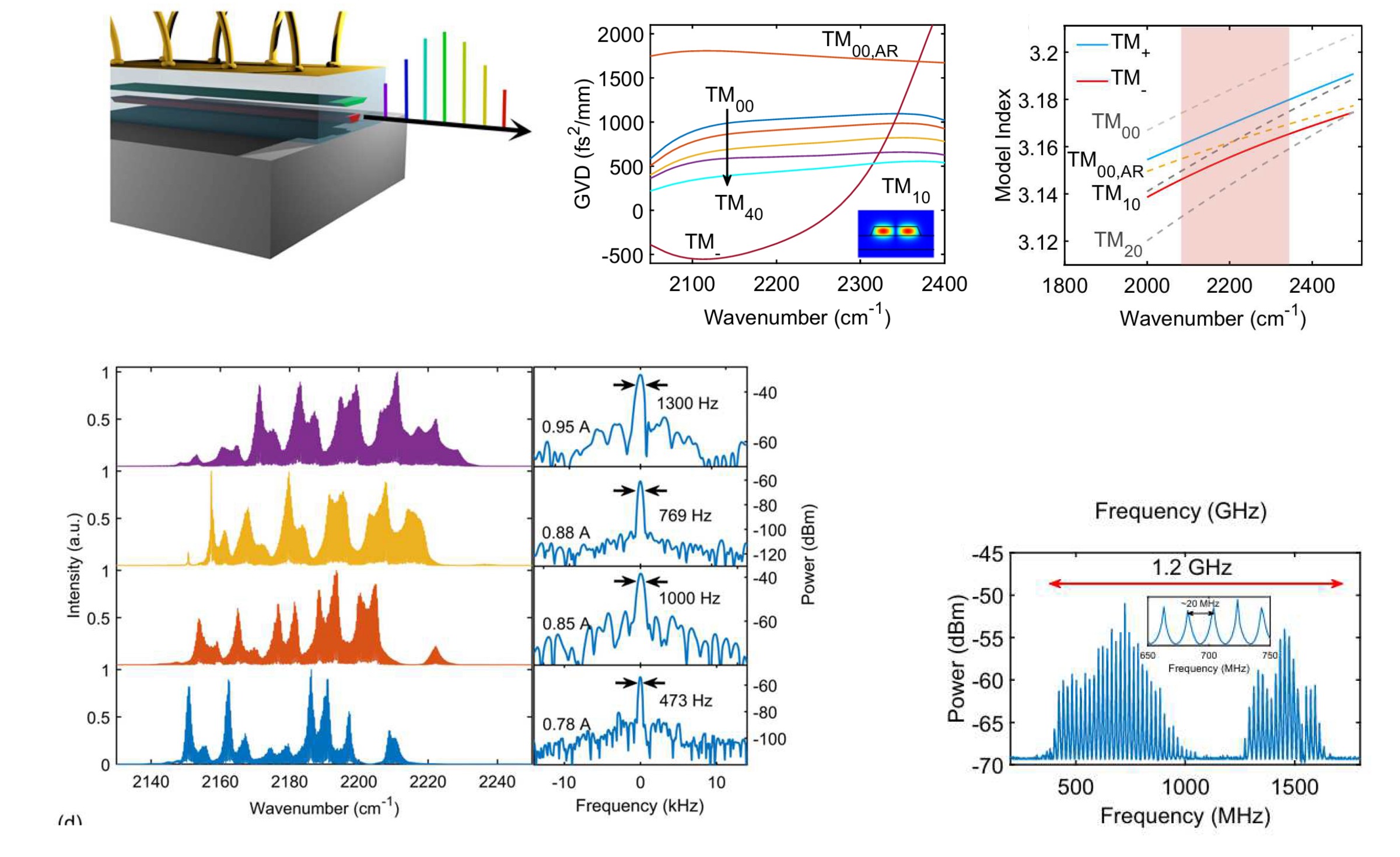
Short-wavelength 3-5 μm QCL frequency combs are highly desirable for precision spectroscopy but are hindered by the large material dispersion. We developed a on-chip integrated multi-mode waveguide dispersion compensation scheme. It introduces a passive high-index waveguide beneath the active region, creating a low-dispersion supermode via evanescent coupling. This design enables a room-temperature frequency comb with over 1 W output power—a tenfold increase for this band—while maintaining <1 kHz beat note linewidth and 95 cm-1 spectral coverage. Verified by dual-comb spectroscopy, this approach provides a promising path for integrated mid-infrared photonics and on-chip sensing.
Research papers:Monolithic dispersion engineered mid-infrared quantum cascade laser frequency comb
Source Article:https://opg.optica.org/prj/fulltext.cfm?uri=prj-12-11-2566&id=562037

Compact, high-performance mid-infrared dual-comb spectroscopy is hindered by the use of external detectors. We developed a self-detected dual-QCL-comb system at ~4.6 μm. Its hybrid monolithically integrated waveguide enables an 16.2 GHz 3 dB bandwidth and effective RF injection locking with extended comb spectral range of 75 cm⁻¹ and high-power (700 mW) as well as narrow beatnote of <1 kHz. The high-speed packed device acts a high-speed detector for multiheterodyne spectroscopy. The system directly captures multi-heterodyne signals over 68 cm⁻¹ without an external detector, with ~10 kHz comb tooth linewidths, advancing system integration and miniaturization.
Research papers:Self-Detecting Mid-Infrared Dual-Comb Spectroscopy Based on High-Speed Injection-Locked Quantum Cascade Lasers
Source Article: https://advanced.onlinelibrary.wiley.com/doi/10.1002/adpr.202500062

Long-wavelength infrared QCLs beyond 9 μm are crucial for molecular detection but face high loss, dispersion, and low power. We address this with a plasmon-enhanced ridge waveguide scheme, engineering group velocity dispersion to -1500 fs²/mm and loss to 5 cm⁻¹ via cladding and plasmonic layer optimization in a single MOCVD step. This yields a room-temperature continuous-wave QCL with 1.06 W power, >50 cm⁻¹ spectrum, 6.4% wall-plug efficiency, and <1 kHz beat note linewidth. In a compact dual-comb system, GaAs etalon and NH₃ absorption lines are measured with 200-400 MHz resolution and 2×10⁻⁴ Allan deviation at 1 ms, enabling high-performance sensing and high-absorption spectroscopy.
Research papers:Longwave infrared dual-comb spectroscopy based on high power quantum cascade lasers
Source Article: https://www.sciencedirect.com/science/article/pii/S1350449525002580
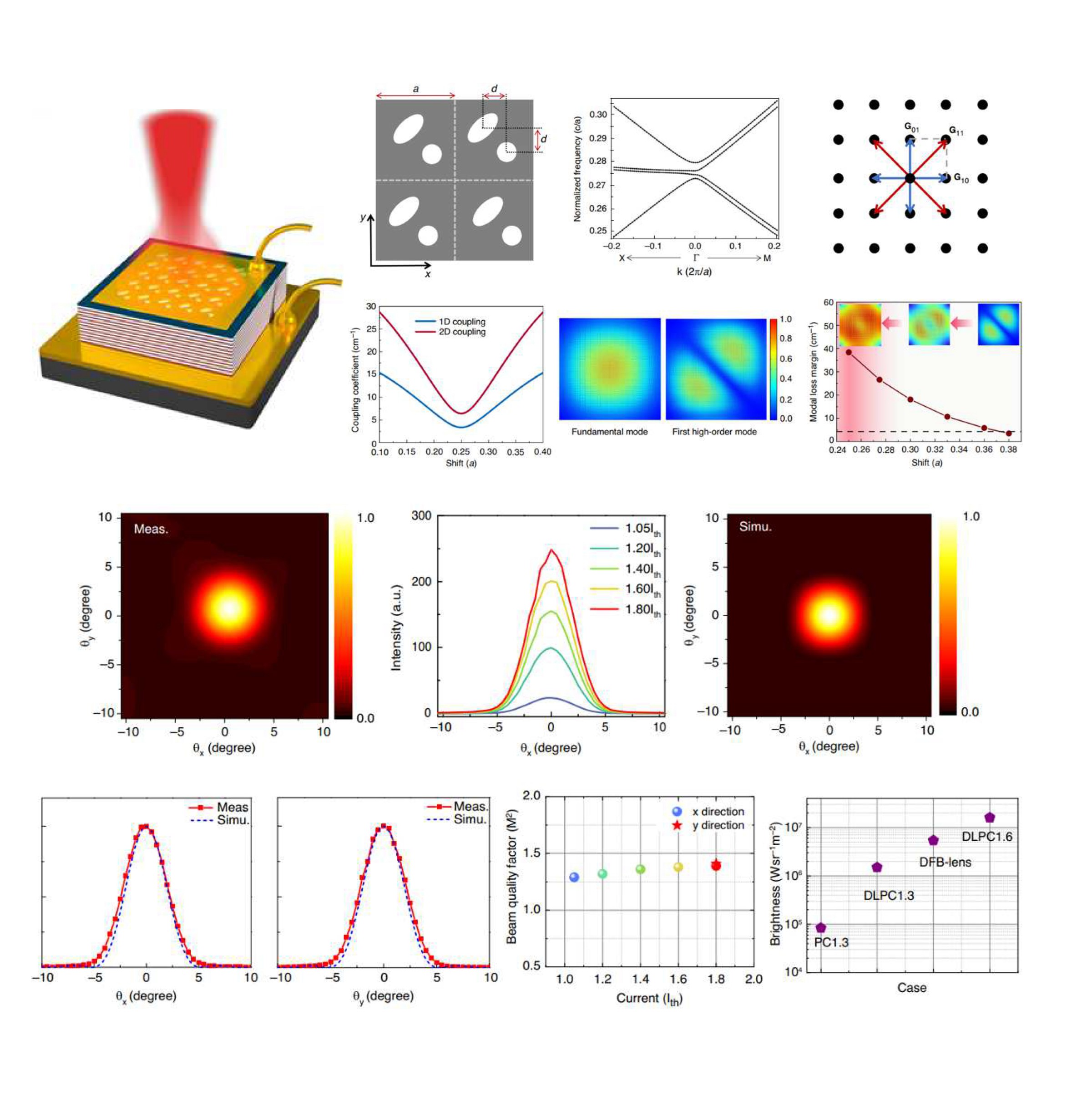
High-power, high-brightness THz QCLs are crucial for applications like security screening and imaging. Conventional designs, however, suffer from multi-mode emission and degraded beam quality when device size increases, severely limiting brightness. We developed a surface-metallic phase-engineered photonic crystal cavity. This design enables stable, single-mode, single-lobe emission from large-area devices (1.6 mm × 1.6 mm). The resulting laser emits at 3.88 THz with >185 mW peak power, a near-diffraction-limited beam (M²=1.4, divergence 4.4°×4.4°), and a brightness of 1.6×10⁷ W·sr⁻¹·m⁻²—several folds brighter than standard DFB counterparts—providing a new pathway to high-brightness THz sources and their applications.
Research papers:High brightness terahertz quantum cascade laser with near-diffraction-limited Gaussian beam
Source Article: https://www.nature.com/articles/s41377-024-01567-2
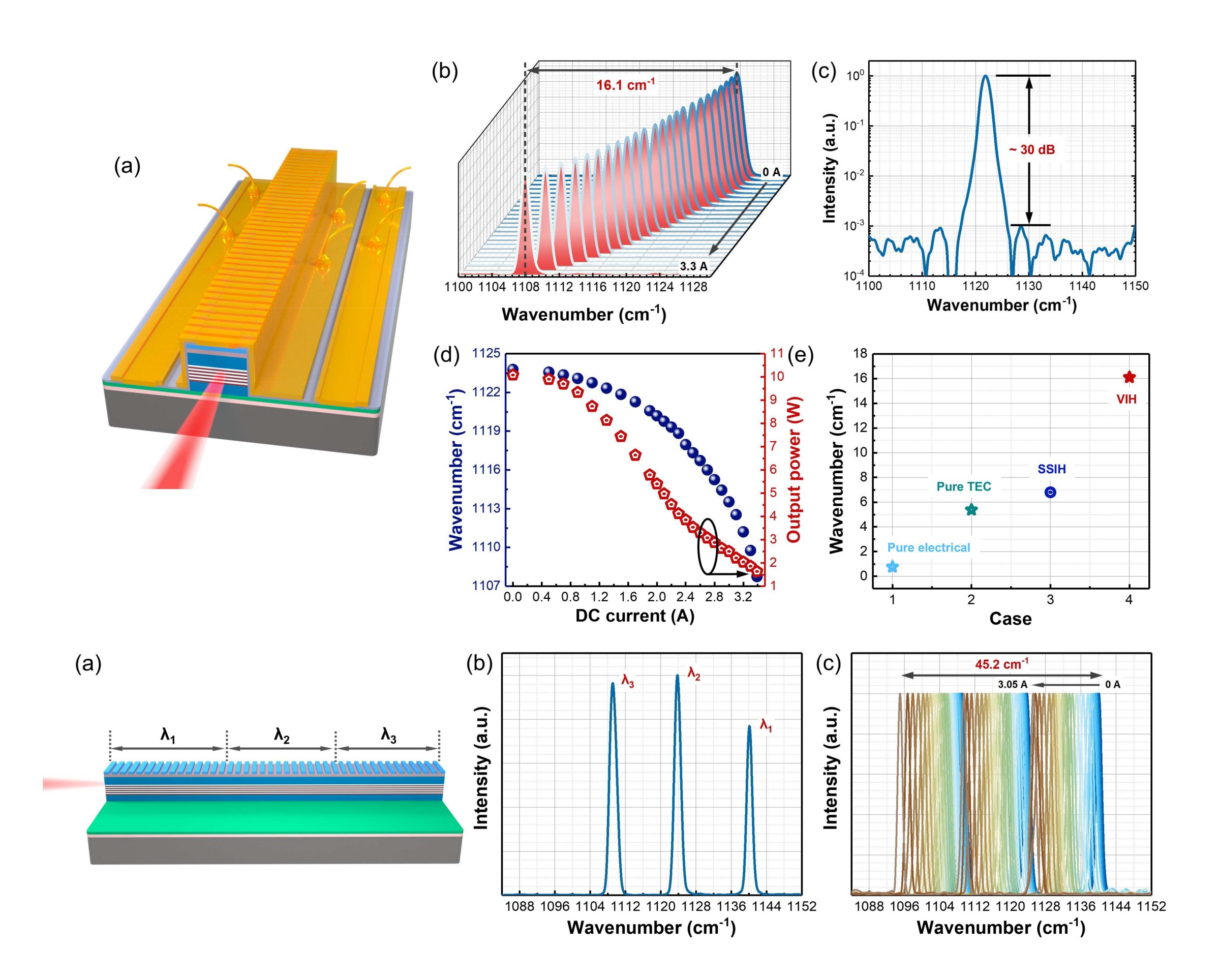
Wavelength-tunable mid-infrared QCLs are essential for trace gas sensing and spectroscopy, yet their tuning ranges in pulsed operation remains limited. We demonstrated an on-chip tuning scheme using a vertically integrated heater (VIH), without using complicated regrowth epitaxy techniques. VIH current modulation achieves a 16.1 cm⁻¹ tuning range, which is expanded to 45.2 cm⁻¹ by integrating a triple-period DFB structure, offering an integrated solution for broadband spectroscopy.
Research papers:On-chip wide tuning of high-power quantum cascade laser based on a vertical-integrated heater
Source Article: https://pubs.aip.org/aip/app/article/10/9/096105/3361844/On-chip-wide-tuning-of-high-power-quantum-cascade

Ideal single-photon sources in the telecom bands are essential for quantum networks but face material growth challenges in achieving high purity and broad spectral coverage. Although near-infrared sources have advanced significantly, extending high performance to the O- and C-bands remains rather challenging. We developed a droplet-epitaxy strategy using metal-organic vapor-phase epitaxy (MOVPE) to synthesize InAs/InP quantum dots (QDs). This method yields QDs with narrow emission lines across λ~1200-1600 nm. Characterization shows a single-photon purity of g²(0)=0.16 and a radiative lifetime of 1.5 ns. Our work establishes a material platform for single photon sources in the telecom bands.
Research papers:Broadband telecom single-photon emissions from InAs/InP quantum dots grown by MOVPE droplet epitaxy
Source Article: https://doi.org/10.1088/0256-307X/43/1/010402
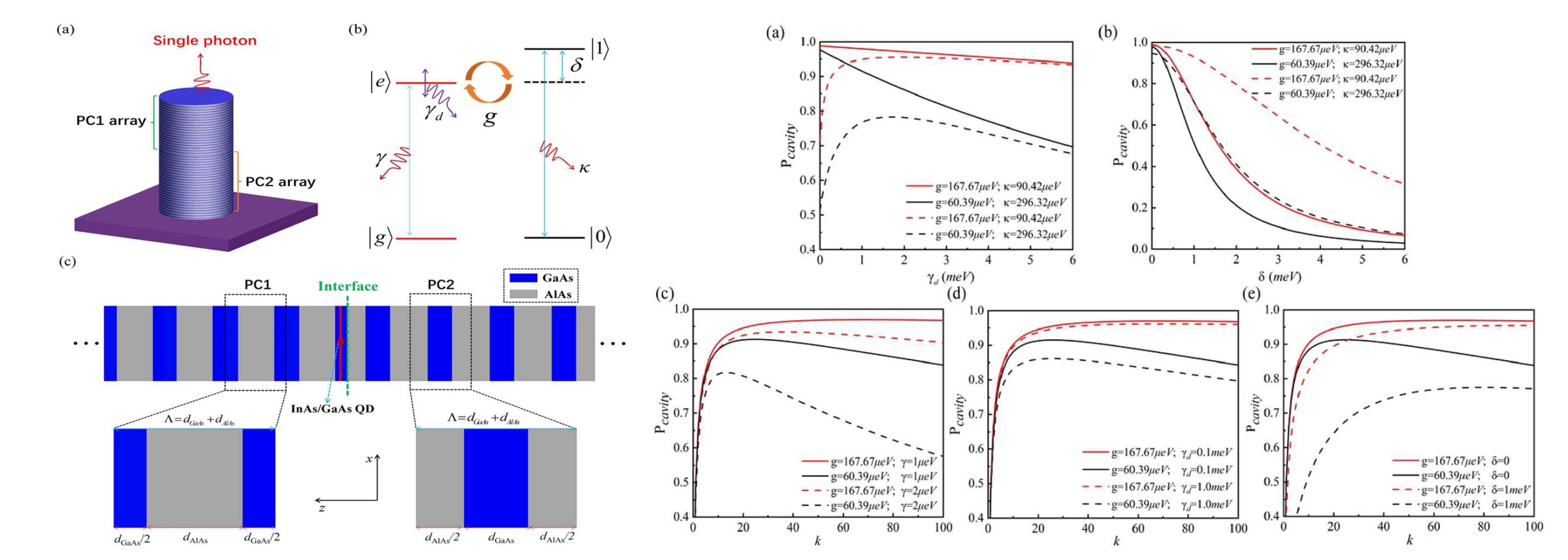
Telecom-band semiconductor quantum dot single-photon sources are crucial for fiber-based quantum networks, yet conventional micropillar cavities suffer from efficiency degradation under realistic conditions of spectral detuning and charge noise. We propose a topologically protected micropillar cavity based on interface states between photonic crystals with distinct Zak phases. This design achieves a quality factor >15,000 and a Purcell factor up to 606 at 1.31 µm. Theoretical analysis shows that, even under significant detuning and pure dephasing, our topological cavity maintains robust single-photon emission with over 90% efficiency, far surpassing conventional designs. Our work provides a theoretical guidance for developing high-performance quantum light sources.
Research papers:Design of topological micropillar cavities for Purcell enhanced single photon emission from semiconductor quantum dots
Source Article: https://doi.org/10.1364/OE.542531